Acupuncture occupies an odd position in British healthcare. It is recommended by NICE, the body that produces clinical guidelines for the NHS. It has a substantial evidence base. And yet most patients have never been offered it on the NHS, and most GPs do not discuss it.
The result is a treatment that works, is endorsed by the UK's official clinical guidelines body, and is almost exclusively accessed privately, by patients who have already found it themselves.
Western medical acupuncture: what it actually is
There are two distinct traditions under the acupuncture umbrella. Traditional Chinese medicine acupuncture is based on the theory of qi flowing through meridians, a framework rooted in ancient philosophy rather than anatomy. Western medical acupuncture, which is what Marcus practises, is based on the neuroscience of how needle insertion affects the peripheral and central nervous system.
When a fine needle is inserted into tissue, it stimulates peripheral nerve endings, triggers local changes in the muscles and fascia, and produces measurable effects on pain processing at spinal and brain level. These mechanisms are not speculative. They are documented, studied, and clinically applied within a physiotherapy framework that integrates acupuncture with assessment, diagnosis and rehabilitation rather than offering it as a standalone ritual.
What the evidence shows
In 2018, the Acupuncture Trialists' Collaboration published an updated individual patient data meta-analysis in the Journal of Pain. This is the gold standard of evidence synthesis: rather than combining summary statistics from different trials, the researchers pooled the raw data from individual patients across multiple high-quality randomised controlled trials. The analysis covered four chronic pain conditions: back and neck pain, osteoarthritis, shoulder pain, and headache.
Across all four conditions, acupuncture was superior to both sham acupuncture and no treatment, with effect sizes that are clinically meaningful. The conclusion was that acupuncture is a reasonable referral option for patients with chronic pain.
NICE Guideline NG193, published in 2021, recommends acupuncture as a treatment option for chronic primary pain, the category that includes musculoskeletal pain persisting beyond the expected healing time. The guideline specifically endorses a course of acupuncture because exercise alone produces insufficient relief for a significant proportion of chronic pain patients.
The conditions it helps most
Chronic back and neck pain. The evidence here is strongest. Acupuncture produces clinically meaningful reductions in pain and disability across multiple trial designs and patient populations.
Osteoarthritis. Particularly knee osteoarthritis, where acupuncture is effective as part of a management plan alongside exercise and education.
Headaches and migraine. NICE includes acupuncture in its guidelines for both tension-type headache and migraine prevention, a point that surprises most patients.
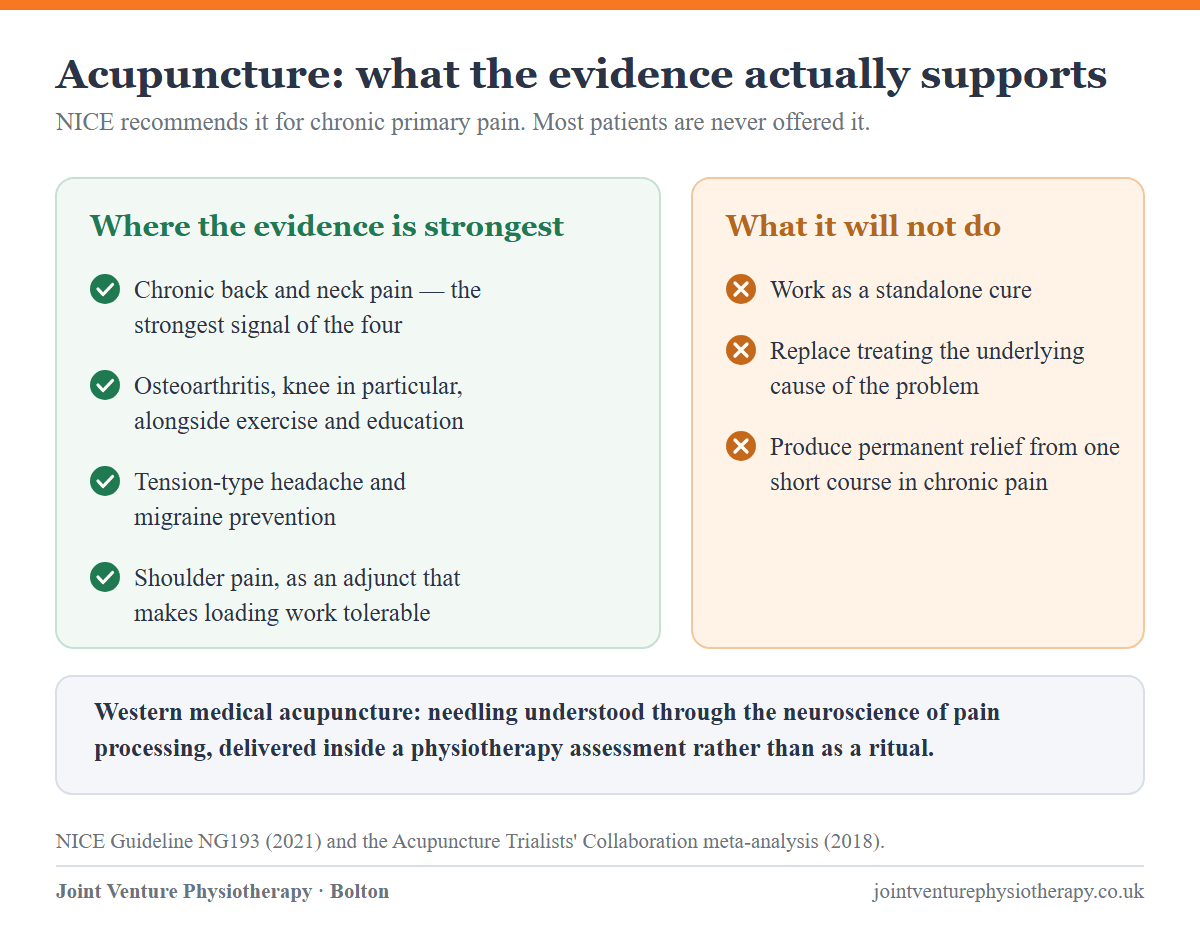
Shoulder pain. Acupuncture works well as an adjunct for tendinopathy and impingement, reducing pain enough to allow more effective exercise rehabilitation.
What it cannot do
Acupuncture is not a standalone cure. The evidence supports it as an effective component of treatment, particularly for pain management, not as a replacement for addressing the underlying cause. For most musculoskeletal conditions, the best outcomes come from combining acupuncture with progressive exercise and manual therapy rather than using any single approach in isolation.
Effects from a short course are not necessarily permanent in chronic conditions. Some patients benefit from periodic maintenance sessions, which is why block bookings at Joint Venture Physiotherapy are offered at a reduced rate.
Safety and what to expect
Delivered by a qualified clinician using sterile single-use needles, acupuncture has an excellent safety profile. Serious adverse events are very rare. Minor reactions, brief bruising or tenderness at insertion sites, are occasionally reported. Marcus screens for contraindications at assessment.
Sessions are 30 minutes. Fine needles are placed at specific sites based on your clinical presentation, not a fixed protocol. They remain in place for fifteen to twenty-five minutes. The sensation during insertion is brief: most patients describe it as a dull ache or heaviness once the needle is in, which is a normal neurophysiological response called deqi. Most patients find it considerably less uncomfortable than they expect.
Acupuncture is available as a standalone session or integrated into a broader physiotherapy programme, which is typically how it produces the best results.