In 2017, The Lancet published a trial that should have changed shoulder surgery. The CSAW study, conducted across 32 NHS hospitals with more than 300 patients, tested arthroscopic subacromial decompression, an extremely common operation for shoulder pain, involving roughly 20,000 procedures in the NHS annually.
It compared the surgery against two controls: a sham procedure (the same anaesthetic and incision, but no actual decompression) and no treatment at all. The results were striking. At six months, all three groups had improved. The surgery produced no significantly better outcomes than cutting into someone's shoulder and closing it back up again.
That's the starting point for understanding shoulder pain in 2025. Most shoulder problems respond to physiotherapy. Surgery should be a last resort, not a first one.
The structures involved
The shoulder is the most mobile joint in the body. That range of motion comes at the cost of stability, making the shoulder dependent on the coordinated function of its muscles, tendons, and capsule in ways that few other joints are. When something goes wrong, the cause is often a combination of load, movement quality, and tissue tolerance rather than a single structural failure.
Rotator cuff injuries
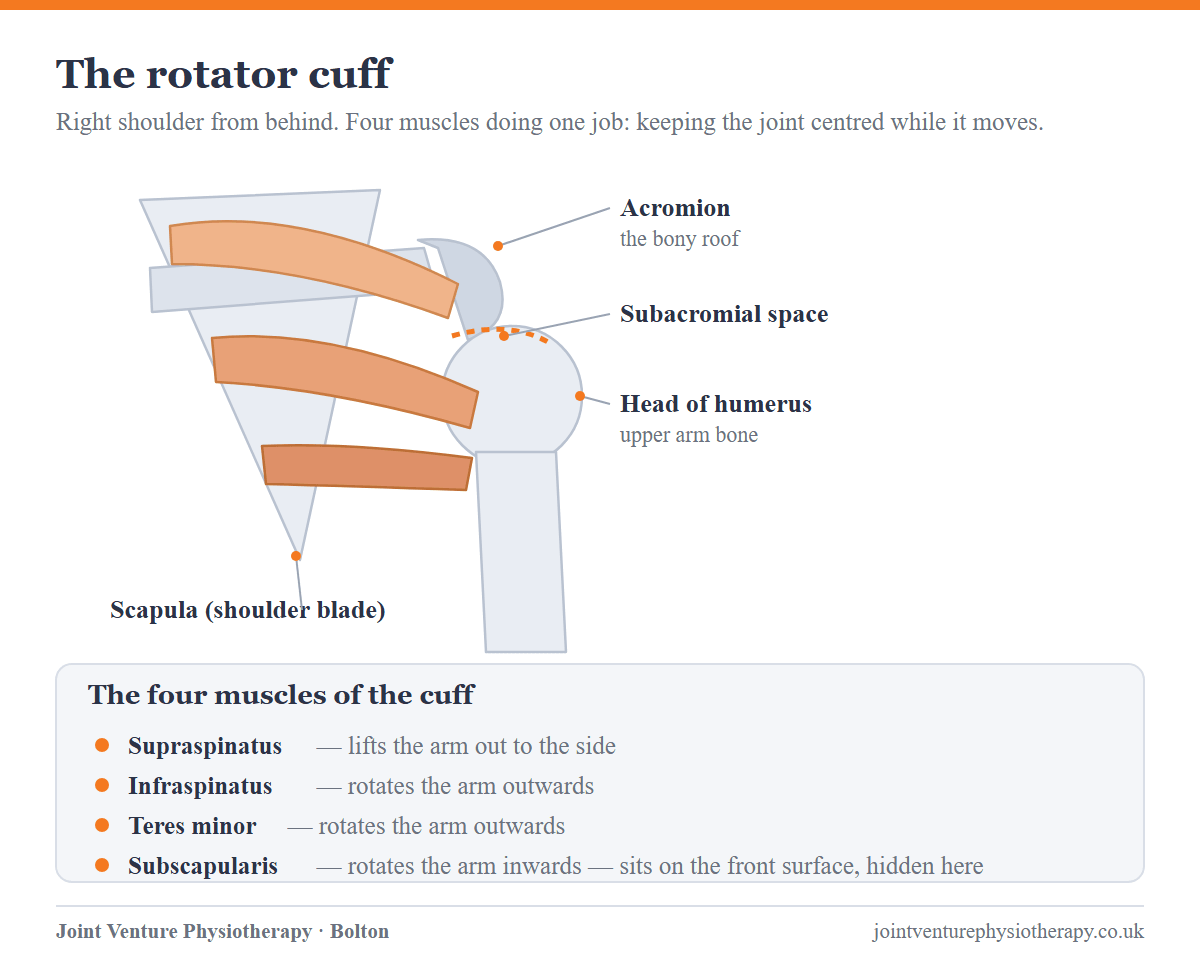
The rotator cuff is a group of four muscles that stabilise and move the shoulder. Rotator cuff tendinopathy, the umbrella term for tendon pain and dysfunction, is one of the most common presentations in musculoskeletal physiotherapy. Symptoms typically include pain with overhead activity, pain lying on the affected side, and weakness with specific movements. Tendinopathy responds well to progressive loading, exercise, and in some cases acupuncture. Rest without rehabilitation is rarely curative.
Shoulder impingement
The term "impingement" describes pain during arm elevation caused by compression of the tendons or bursa in the subacromial space. The CSAW trial was specifically testing this condition. Its conclusion was that the problem is not a structural one requiring surgical correction, but a functional one that physiotherapy can address through exercise, movement retraining and manual therapy.
Frozen shoulder
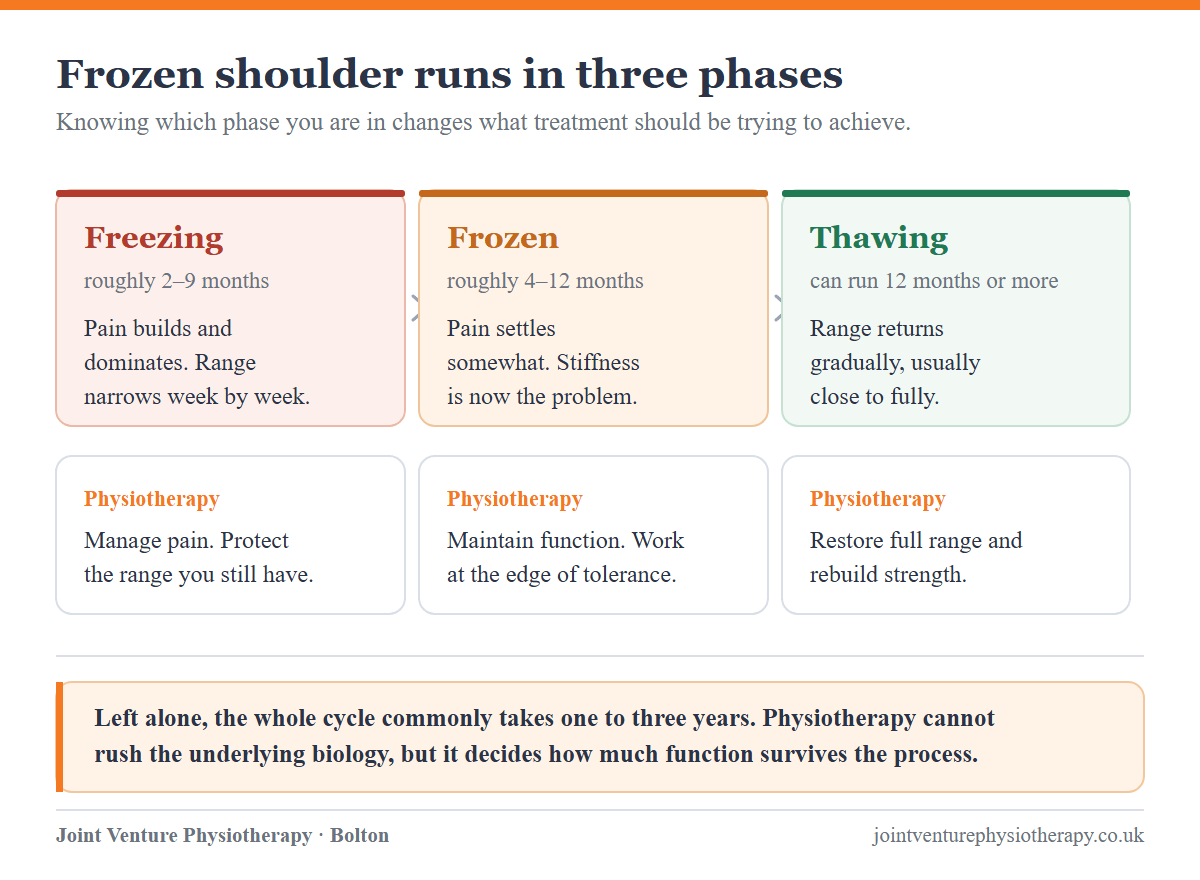
Adhesive capsulitis, commonly called frozen shoulder, involves progressive stiffening and inflammation of the shoulder capsule. It typically runs in three distinct phases: a painful "freezing" phase, a stiff but less painful "frozen" phase, and a slow "thawing" as mobility returns. The process can take one to three years without intervention. Physiotherapy cannot accelerate the underlying biology entirely, but it can manage pain, maintain as much function as possible throughout each phase, and ensure the shoulder recovers fully during the thaw.
AC joint injuries
The acromioclavicular joint sits at the top of the shoulder where the collarbone meets the shoulder blade. It is commonly injured in contact sport and falls. Tenderness localised to the top of the shoulder, often with a visible bump, is characteristic. Most AC joint injuries are managed conservatively with physiotherapy.
Labral tears
The labrum deepens the shoulder socket and provides dynamic stability. Tears are more common in overhead athletes, swimmers, and those who have dislocated the shoulder. A physiotherapy rehabilitation programme can restore sufficient stability and strength for most people to return to full activity without surgery.
How your shoulder will be assessed
Marcus will take a full history at your first appointment: when the problem started, what caused it, what movements are painful, whether the pain is localised or refers into the arm. A physical examination follows, testing range of motion, strength, and specific orthopaedic tests that identify which structure is involved.
For most presentations, clinical assessment alone provides sufficient information to diagnose and begin treatment. Where imaging adds something, Marcus will advise on what's appropriate and why. That conversation is much more useful when the clinical picture is clear first.
What treatment involves
The evidence base for shoulder physiotherapy is strong. Manual therapy, progressive exercise targeting the rotator cuff and scapular stabilisers, movement retraining, and acupuncture as an adjunct for pain management all have good support in the research literature. The specific combination depends on the diagnosis, the stage of the problem, and your goals.
Most acute shoulder presentations, including rotator cuff strains, impingement syndrome, and AC joint injuries, respond significantly within four to eight sessions. Frozen shoulder and more complex instability presentations require longer.
One thing worth knowing: shoulder pain that is left untreated tends to become chronic. The longer a movement problem persists, the more the surrounding muscles compensate and the harder the pattern is to reverse. Early treatment produces faster, more complete recovery.
Book a shoulder assessment in Bolton
No GP referral needed. Same-week appointments available at Joint Venture Physiotherapy, with evening and Saturday slots for those who work during the week.